

What is the difference between office chair mechanisms?
- Updated:
About the author:

John Karle
“Create Healthy Workspaces”
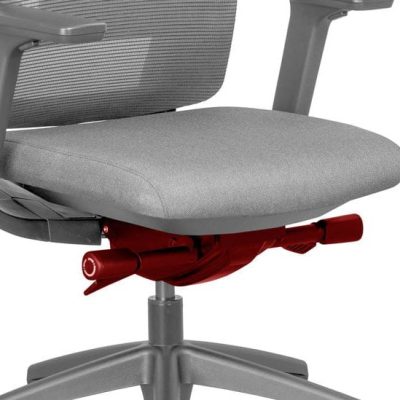
Located underneath the seat of an office chair is the chair mechanism. This is a mechanical component that enables you to make specific adjustments to the seat and backrest of the chair, for example the seat height and angle of the backrest. The mechanism allows you to personalise your seat position for optimal comfort and support. Office chair mechanisms control how the seat and backrest move. Why a fully adjustable office chair is important.
The six main types are swivel-only, swivel & tilt, frontal-pivot tilt, permanent-contact, synchronous (synchro) and free-float mechanisms. Synchro and free-float mechanisms provide the best ergonomic support because they encourage dynamic sitting and continuous movement throughout the workday.
In summary: Synchro and free-float mechanisms are generally regarded as the best office chair mechanisms because they promote dynamic sitting, improve spinal support and reduce muscle fatigue during long periods of desk work.
The mechanism is the “heart” of an office chair.
Selecting the right one can make all the difference for your long-term comfort. Latest Trends in Selecting a Comfortable Office Chair.
Most types of office chair mechanisms have multiple adjustment levers and knobs which control the various movements, namely, seat height, backrest tilt, seat tilt, tilt tension, and seat depth. The Centripetal Spring Arm Chair of 1849 was the first to include a mechanism – history of office chairs.
Let’s take a look at all the major office chair mechanism types and discuss their differences and how they work.
Static and Dynamic Sitting
a. Static Seating
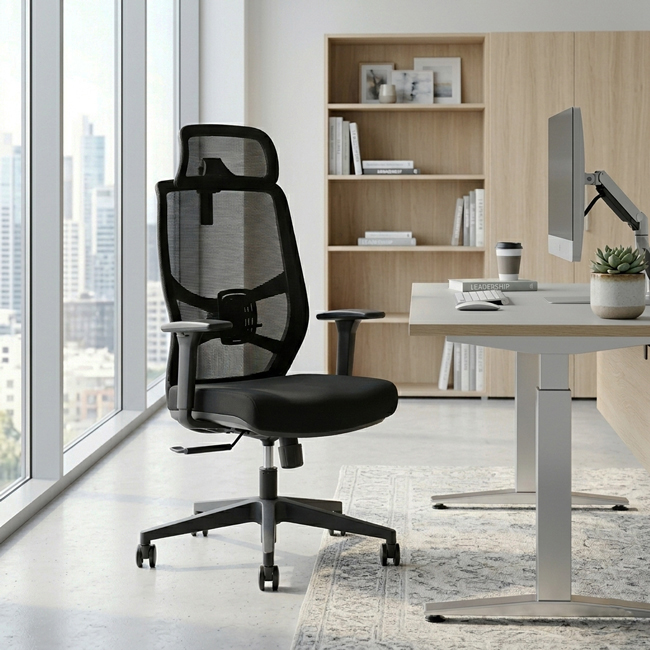
Ergonomic office chairs should allow both “static” and “dynamic” sitting. The correct static seated position is shown below:
- Feet are resting flat on the floor or on a footrest.
- Knees are slightly below the level of your hips so that the angle between you back and thighs is between 90 and 100 degrees. Your knees should be bent at approximately 90 degrees.
- Arms are well supported by the armrests with your elbows bent at about 90 degrees.
- Hands and wrists are at the same height as the desk.
- Back is supported by the chair backrest and lumbar support.
- Shoulders and neck are relaxed and your head straight.
- The monitor should be approximately an arms-length away, with the upper edge of the screen at about eye level.
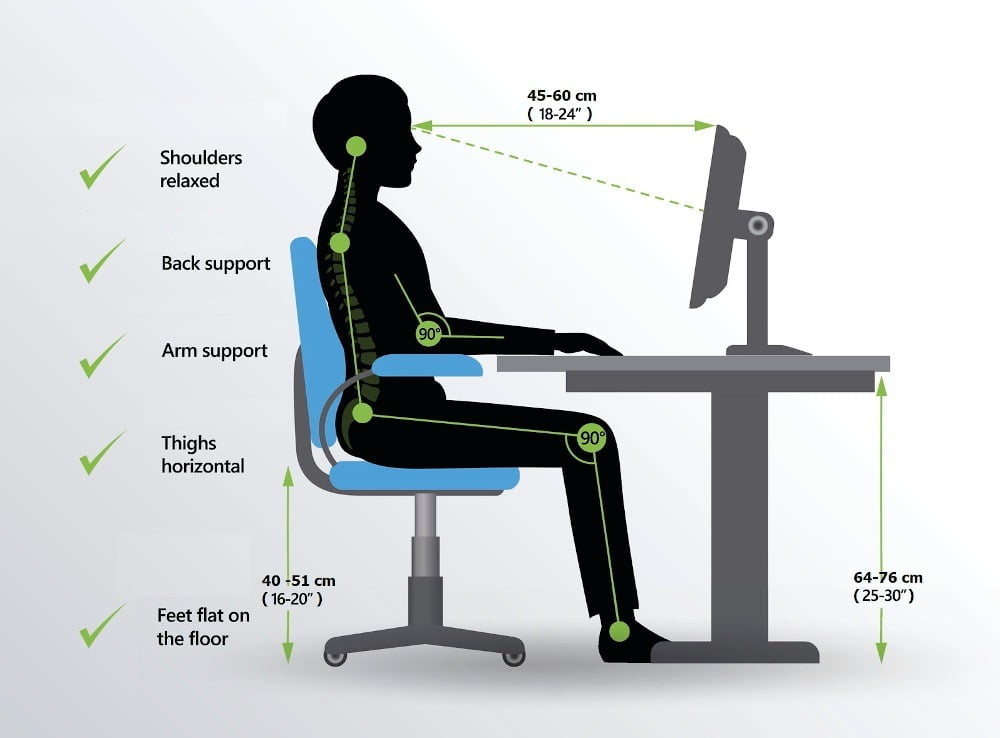
Sitting statically in the above posture minimises the strain on your body. However, maintaining this posture for a long period is not possible. As you work, the continual inactivity (or static loading), of your core muscles causes them to get tired, and so you begin to slouch in your chair.
For optimum comfort, you should be able to continuously alternate between a static and dynamic seated posture, and the mechanism on your office chair should facilitate this.
b. Dynamic Seating
Dynamic Sitting occurs when you continuously change the angle between your back and thighs when you sit, or in other words, the angle between the seat and backrest on your office chair.
- By doing so, you automatically stimulate, or activate various muscles in your lower back, core and legs.
- As a result, the blood flow through these muscles increases, bringing oxygen and other nutrients to the muscles and carrying away the waste products of muscle metabolism.
- This action reduces muscle fatigue and its associated pain, particularly in the lower back, core and legs.
- Dynamic sitting minimises static muscle loading and improves long-term sitting comfort.
Office chairs fitted with either a Synchronous (synchro) or a Free-Float mechanism, encourage or aid Dynamic Sitting.
Dynamic Sitting has long been acknowledged as the global benchmark for ergonomic comfort. An office chair fitted with a mechanism that facilitates dynamic sitting, is more comfortable.
Types of Office Chair Mechanisms
There are 6 major types of mechanisms available for office chairs, all of which will allow you to adjust the height of the seat. With the exception of the swivel-only mechanism, they all provide additional functionality.
Quick Office Chair Mechanism Comparison Table
Mechanism Type | Dynamic Sitting | Best for | Rating |
|---|---|---|---|
Swivel-only | No | Stools | 1/5 |
Swivel & Tilt | No | Short-term use | 1/5 |
Frontal Pivot | No | Short-term use | 1/5 |
Permanent Contact | Limited | Short-term use | 2/5 |
Synchro | Yes | Intensive office use | 4/5 |
Free-Float | Yes | Advanced requirements | 5/5 |
1. Swivel-Only Mechanism
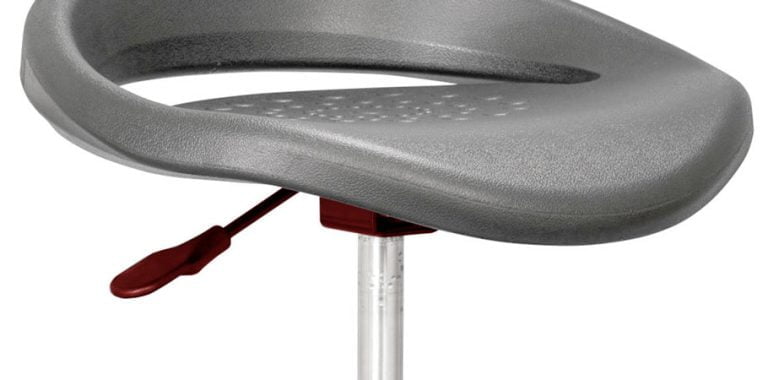
The Swivel-Only Mechanism is typically found on a sit/stand stool where you continuously alternate between sitting and standing. Good examples are laboratories, factories and salons.
2. Swivel & Tilt Mechanism
This mechanism is found in office chairs where the seat and backrest are one continuous piece. In these chairs, you can’t adjust the seat and backrest separately; they always move together.
The pivot point for these mechanisms is usually in the center of the seat. This means that when you lean back, the front edge of the seat will lift your feet, increasing pressure on the underside of your thighs.
3. Frontal-Pivot Tilt Mechanism
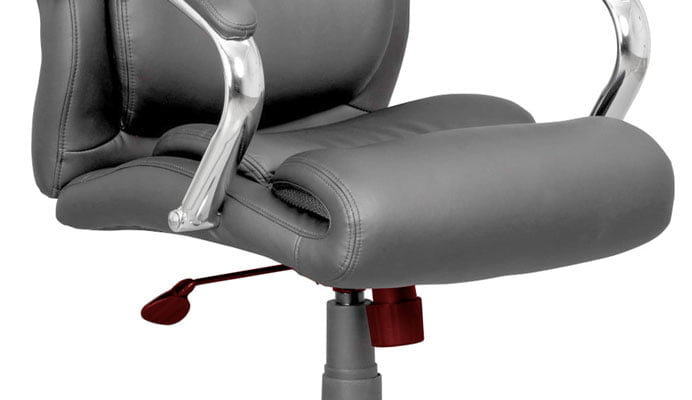
A Frontal Pivot or Knee-Tilt office chair mechanism is similar to a regular Swivel & Tilt chair. The difference is that its pivot point is located closer to the front of the seat rather than in the center. This design allows for a wide-angle tilt that keeps the front of the seat more level. Unlike a standard swivel & tilt mechanism, a frontal pivot does not create added pressure on the underside of your thighs when the chair tilts back.

4. Permanent-Contact Mechanism
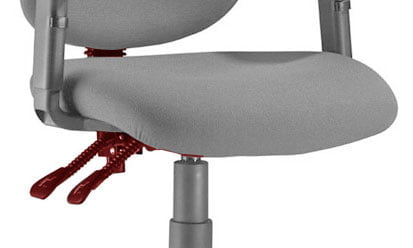
A Permanent Contact or Back-Rake Mechanism lets you adjust the angle of the backrest while the seat stays flat. Chairs with this mechanism are best for occasional use, not heavy use.
This mechanism allows you to lock the backrest in any position, known as infinite lock. Usually, you can also adjust the backrest height to match the curve of your spine.
5. Synchronous (Synchro) Mechanism
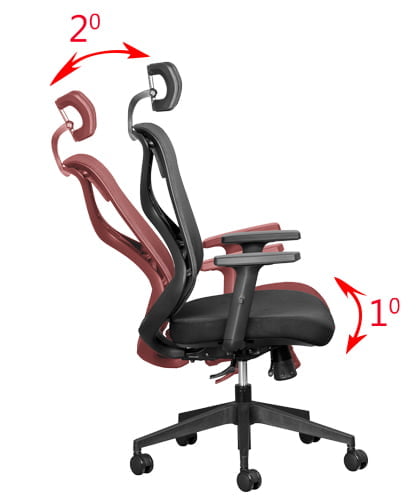
Synchro mechanisms have a mechanical tilt that moves both the chair’s backrest and seat together in a fixed ratio. All synchro mechanisms ensure that the movement of the backrest is greater than the movement of the seat. Typically synchro mechanisms have a 2:1 ratio i.e. the backrest moves 2 degrees for every 1 degree of movement in the seat.
The seat and backrest can be locked into a number of static positions. If the mechanism is unlocked, it will be in a free-float position. In this position, the chair is dynamic and the backrest gives continual back support by moving with you.
A synchro tilt mechanism enables dynamic sitting and is therefore recommended for professional intensive use.
6. Free-Float Mechanism
A Free-Float or Multi-function mechanism allows you to independently adjust the angles of the backrest and seat of the chair.
This enables you to customise the exact angle of the seat and backrest to create your optimal sitting posture.
All orthopedic office chairs use a Free-Float mechanism.

Which Office Chair Mechanism is Best?
The best office chair mechanism depends on how long you sit each day:
- Less than 2 hours: Swivel-only, Swivel & Tilt or Frontal-Pivot
- 2–4 hours: Permanent Contact
- More than 4 hours: Synchro or Free-Float
If you spend most of your day working at a computer, a Synchro or Free-Float mechanism is recommended because it promotes dynamic sitting and reduces static muscle loading.
Based on our experience supplying ergonomic office chairs to South African users for more than 40 years, synchro and free-float mechanisms consistently deliver the highest levels of comfort, support and user satisfaction.
Frequently Asked Questions (FAQ's) About Office Chair Mechanisms
a. What is an office chair mechanism?
An office chair mechanism is the mechanical assembly located beneath the seat that controls functions such as seat height adjustment, backrest movement, seat tilt and tilt tension.
b. Which office chair mechanism is best?
For most office workers, a synchro mechanism provides the best balance of comfort, movement and support. For anyone with existing back-related issues, a free-float mechanism offers the highest level of adjustability.
c. What is a synchro mechanism?
A synchro mechanism allows the seat and backrest to move together in a fixed ratio, typically 2:1. This encourages dynamic sitting and maintains back support as you recline.
d. What is the difference between a synchro and free-float mechanism?
A synchro mechanism links seat and backrest movement in a predetermined ratio. A free-float mechanism allows the seat and backrest angles to be adjusted independently for maximum customisation.
e. Is a free-float mechanism better than a synchro mechanism?
A free-float mechanism offers greater adjustability and is commonly used on orthopedic office chairs.
- If you’re generally healthy and want a comfortable office chair that prevents back pain, choose an ergonomic chair with a synchro tilt mechanism.
- If you have a pre-existing medical condition like sciatica or chronic back pain, an orthopedic chair fitted with a free-float mechanism is the better choice.
Orthopedic vs Ergonomic Office Chairs: What’s the Difference and Which Should You Choose?
f. Does an office chair mechanism affect posture?
Yes. The mechanism determines how the chair supports movement and posture throughout the day. Advanced mechanisms such as synchro and free-float designs help maintain spinal alignment and reduce static loading.
g. Which office chair mechanism is best for back pain?
Both synchro and free-float mechanisms can help reduce lower back discomfort by promoting movement throughout the day. However, free-float mechanisms provide greater adjustability and are often preferred for users with existing back-related issues.
h. Is a synchro or free-float mechanism worth it?
Yes. A synchro or free-float mechanism are worth the additional cost if you spend more than four hours per day sitting at a desk. They promotes dynamic sitting, improve comfort and provide better ergonomic support than basic tilt mechanisms.
Conclusion
The mechanism is the most important ergonomic component of an office chair. While basic tilt mechanisms provide limited movement, synchro and free-float mechanisms actively support dynamic sitting and are generally the best choice for people who spend long hours at a desk. When comparing office chairs, understanding the mechanism is often more important than focusing solely on the chair’s appearance.
Related articles:
How do I choose the best office chair for me?
What influences the price of an office chair?
What is the difference between office chair armrests?
By the same author:

What Is An Ergonomic Chair And How Do I Select My Ideal Seat?
There are many options available, but what is an ergonomic office chair? What features must it have? How do you make the right choice?

Office Furniture Suppliers for Ergonomic Solutions
Choosing the right office furniture suppliers in South Africa is crucial for creating a productive, comfortable, and stylish workspace.
How to Choose the Best Office Chair: 6 Questions to Ask Before You Buy
Trying to choose an office chair for yourself can be confusing. Let us make the process a whole lot simpler.