

Don’t Buy Office Furniture Without a Workplace Risk Assessment
- Updated:
About the author:

John Karle
“Create Healthy Workspaces”
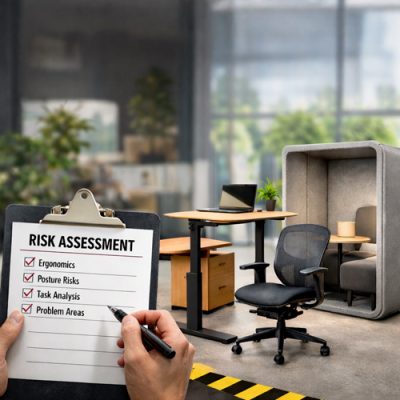
When it comes to buying office furniture, most companies make the same mistake: they start with products. New chairs, height-adjustable desks and office pods are chosen straight from a catalogue. But without a proper ergonomic workplace risk assessment, even the best furniture is just an expensive guess. As a corporate buyer, facilities manager, or HR leader, the last thing you want is to invest heavily, only to find that the complaints keep coming in. Your task is not to 'buy furniture', it is to reduce risk, protect the staff and make defensible investment decisions. That starts with understanding the risks inside your workplace.
Table of Contents
"Buying office furniture without a risk assessment is like buying shoes for a whole family without knowing anyone’s shoe size.
It's expensive, someone’s going to end up with blisters, and you'll eventually have to replace them all anyway."
Executive Summary
- Buying furniture without assessing risk leads to avoidable financial exposure.
- Poor ergonomics increases presenteeism, absenteeism and staff turnover.
- Workstation design forms part of employer duty of care.
- A documented ergonomic risk assessment strengthens governance and ESG credibility.
- Furniture should be specified based on risk profile, not selected from a catalogue.
What Is an Ergonomic Workplace Risk Assessment?
An ergonomic workplace risk assessment is a documented process that evaluates how employees interact with their workstation, seating, desk, screen equipment and environment to identify risks that may cause musculoskeletal injury or productivity loss. It assesses posture, adjustability, task demands, user diversity and environmental factors.
The goal is to prevent predictable injury, strengthen employee wellbeing, limit the hidden costs of poor ergonomics, and establish a documented record of due diligence.
The Hidden Financial Cost of Poor Ergonomics
Poor ergonomics in the office is not a comfort issue; it's a measurable financial exposure. The cost of bad ergonomics to an organisation is usually far higher than leaders expect because most of it is hidden. Across most organisations, the biggest cost is not injury claims, but avoidable costs that manifest themselves as follows:
a. Presenteeism
Presenteeism is when employees are physically at work but are working in pain or discomfort. This decreases productivity as they:
- Work more slowly
- Lose focus faster
- Make more errors
- Take frequent micro-breaks.
Even a conservative 5–10% productivity drag is significant.
For example: 100 staff, average salary R300k pa, a 10% productivity drop equates to a R3 million annual company cost.
b. Absenteeism & Musculoskeletal Disorders
According to the World Health Organisation, musculoskeletal conditions are the leading contributor to disability globally. Back pain in the office, neck strain and repetitive strain injuries increase:
- Sick leave
- Temporary staffing costs
- Project delays
- Management time.
Even 1–2 additional sick days per employee per year becomes expensive at scale.
c. Staff Turnover
Employees that resign never say: “I’m leaving because of my chair", but they do say:
- "I am always tired at work"
- "I often get headaches when I work in this office"
- "This place is noisy, uncomfortable and the lighting is bad".
According to Executive Network, the cost of replacing an employee that has left can be up to 200% of their annual salary.
d. Equipment and Environmental Waste
Cheap desks and non-ergonomic chairs often:
- Fail within 12–24 months
- Lack the adjustability required to accommodate the mix of people found in most offices
- Cause or exacerbate complaints and back injuries.
This leads to repeat purchasing, environmental waste and inconsistent standards across departments.
Why Ergonomic Risk Is a Governance Issue
Ergonomics is not a facilities preference or a procurement decision, it's a governance responsibility. Workstation design sits at the intersection of occupational health, financial performance, regulatory compliance and duty of care. When unmanaged, ergonomic risk becomes an organisational liability.
International frameworks such as International Organisation for Standardisation (ISO) and Health and Safety Executive in the UK (HSE), all recognise workstation design as part of workplace safety obligations. Employers have a legal obligation to prevent foreseeable harm, and poorly designed workstations fall squarely into that category.
In the event of a claim, the defensibility of your position depends not on the quality of the chair or desk purchased, but on whether a documented ergonomic workplace risk assessment process exists.
A workplace risk assessment transforms ergonomics from reactive spending into evidence-based risk management.
Product invoices are not risk controls. Documented assessment processes are.
a. Injury Exposure and Legal Liability
Back pain, nerve compression and repetitive strain injuries are cumulative conditions linked to sustained posture, repetitive motion and inadequate adjustability.
If workstation design contributes to these conditions, it can lead to:
- Injuries and Workers Compensation claims
- Legal disputes
- Reputational damage
b. Compliance
Workplace ergonomics supports the “Social” pillar of Environmental, Social and Governance (ESG) by:
- Protection of employee wellbeing
- Structured health risk mitigation
- Evidence-based investment decisions
If questioned by auditors or board members, can you demonstrate a structured ergonomic risk process, or only product invoices?
c. Insurance and Risk Profiling
Insurers assess organisational risk maturity. Poor claims history linked to musculoskeletal injury can influence:
- Premium levels
- Excess thresholds
- Underwriting scrutiny
A documented ergonomic assessment program signals risk discipline that can strengthen your overall risk profile.
d. Talent and Company Reputation
Employees expect safe, well-designed workplaces. If your environment causes fatigue and discomfort, it erodes trust. Employer reputation now spreads rapidly through social media and consistent complaints about workplace discomfort can quickly damage your brand.
A formal ergonomic program communicates that employee wellbeing is managed deliberately, not improvised.
Good Governance Requires a Process
Ergonomic risk cannot be eliminated entirely, but it can be identified, prioritised and reduced. An ergonomic workplace risk assessment provides:
- A documented risk profile
- Prioritised mitigation actions
- Evidence to support procurement decisions
- A defensible audit trail.
This shifts ergonomics from discretionary spending to structured governance, and that shift changes the conversation from
“Which desk and chair should we buy?” to “How are we managing foreseeable workplace risk?”
The Ergonomic Workplace Risk Assessment Process
1. Identify job roles and task demands
Assess how long employees sit, type, take calls or alternate between tasks.
2. Evaluate workstation setup
Review chair adjustability, desk height, monitor positioning and equipment layout.
3. Assess user diversity
Consider 5th–95th percentile height ranges and weight ratings.
4. Review environmental factors
Lighting, noise, temperature and layout constraints.
5. Prioritise risk severity
Categorise issues as high, medium or low impact.
6. Specify controls
Align chair and desk specifications to identified risks.
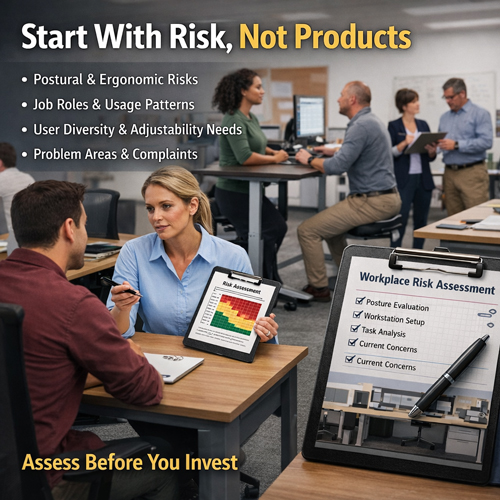
Without a proper workplace risk assessment, you're buying office furniture reactively. With it, you create a furniture procurement roadmap.
You’re Not Expected to Do an Ergonomic Workplace Risk Assessment Alone
If reading “workplace risk assessment” feels overwhelming, you’re not alone. The good news? You have three clear, practical options, each with different cost implications.
Option 1: Your Internal Health & Safety Department
If your organisation has an established Health & Safety team, they may already be equipped to conduct ergonomic and workplace risk assessments.
This option works well when:
- Your internal team has ergonomic competency
- You have structured H&S processes in place
- You want the assessment managed internally
- Budget control is a priority.
This approach carries no additional external cost, provided your team has the required expertise and capacity.
Option 2: An Independent Specialist
For organisations wanting an external, specialised evaluation, companies like Ergomax Holdings focus specifically on workplace risk assessment.
This option is ideal when:
- You need independent expertise
- You’re addressing widespread discomfort or injury trends
- You want formal documentation and reporting
- You’re undertaking a large-scale workplace upgrade.
An external specialist often brings deep ergonomic knowledge and objectivity, along with structured reporting.
Option 3: Karo Workplace Risk Facilitators
At Karo Manufacturing, we have trained Office Ergonomics Risk Facilitators who assess the risk within your current desk and chair setup before any furniture specification begins.
This option works well when:
- You’re planning a furniture upgrade
- You want risk assessment and product alignment to work together
- You prefer a coordinated, streamlined approach
- You want cost efficiency linked to your procurement process.
The cost of this assessment is waived if furniture is purchased from Karo.
Why A Workplace Risk Assessment Matters
When risk is not properly identified:
- Employees continue to experience discomfort
- Adjustability features go unused
- Absenteeism may increase
- Complaints shift from one issue to another
- Furniture budgets are stretched without measurable improvement.
But when you begin with a clear risk profile:
- Furniture selection becomes evidence-based
- Adjustability matches real user diversity
- Investment aligns with actual job tasks
- Decision-making becomes easier and defensible.
When risk is clearly defined, product selection becomes secondary
Move from reacting to complaints, to proactively designing a healthier workplace.
The 7 Signs Your Workplace May Have Ergonomic Risk
- Frequent back or neck complaints
- Rising sick leave related to musculoskeletal pain
- Employees bringing their own cushions or footrests to work
- Chairs adjusted incorrectly or not at all
- High staff turnover in desk-based roles
- Complaints about fatigue or headaches
- Repeated furniture replacement cycles.

Global Standards for Ergonomic Workplaces
To ensure the workplace risk assessment is ergonomic and "defensible," it should firstly reference international benchmarks like the correct sitting posture and secondly, include minimum specifications for ergonomic chairs and desks.
a. Correct Sitting Posture
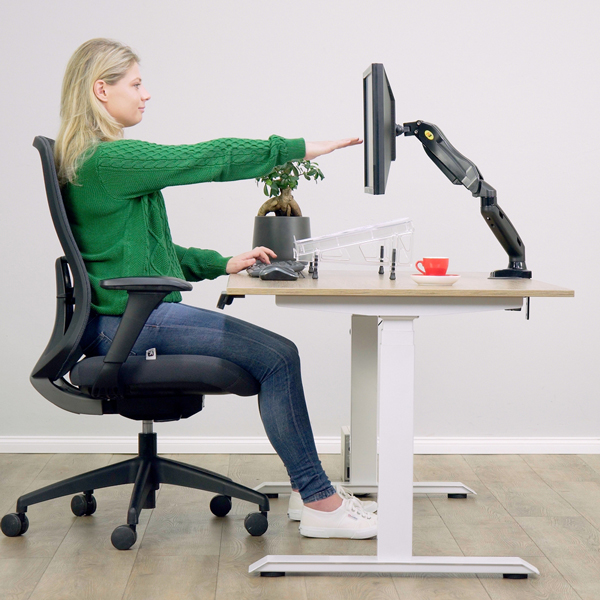
The correct sitting posture follows the 90-90-90 rule whereby:
- Hips at 90° to 100° to maintain the pelvic tilt
- Knees slightly below the level of the hips so the angle of the knees is 90° or greater
- Feet flat on the floor or on a footrest
- Top of the armrest in line with the top of the desk so elbows are at 90° and can rest comfortably on the desktop or armrest pads
- Monitor should be about an arms-length away
- Top of the monitor at or slightly below eye-level
- Back fully supported and lumbar cushion correctly positioned
- 2-3 finger gap between the inside of the knees and the front edge of the seat.
b. Minimum Specifications for Ergonomic Chairs in Corporate Offices
Any office chair purchased for general and intensive office use (up to 12 hours per day), should meet certain requirements. These are not luxury features, but minimum requirements for risk mitigation in general office use environments.
Feature | Minimum requirement | Preferred |
|---|---|---|
Tilt Mechanism | Synchronous or Free-Float tilt that allows Dynamic Sitting | Multi-position tilt lock, tilt tension adjustment or auto tilt-tension |
Seat Height Adjustment | Gas height adjustment suitable for 5th–95th percentile users | Heavy-duty gas lifter |
Approx. 40mm travel | Seat slider locks in multiple positions | |
Lumbar Support | Height adjustable | Height & depth adjustable |
Armrests | Adjustable with soft-touch pads | 4D armrests (Height, Width, Depth & Pivot adjustment) |
120kg | 150kg | |
Warranty | 5 years | 10 years |
Compliance | ISO/EN/BIFMA certified | Additional ergonomic awards, eg. Ergomax |
Feature | Minimum requirement |
|---|---|
Tilt Mechanism | Multi-position tilt lock, tilt tension adjustment or auto tilt-tension |
Seat Height Adjustment | Gas height adjustment suitable for 5th–95th percentile users |
Approx. 40mm travel lockable in multiple positions | |
Lumbar Support | Height adjustable. preferably also depth adjustable |
Armrests | Adjustable 4D with soft-touch pads |
120kg, preferably 150kg | |
Warranty | 5 years, preferably 10 years |
Compliance | ISO/EN/BIFMA certified. Additional ergonomic awards, eg. Ergomax |
c. Minimum Specifications for Standing Desks in Corporate Offices
Desks should be height adjustable to accommodate the varying demographics and work needs within an organisation, and they should meet the following minimum requirements:
Feature | Minimum requirement | Preferred |
|---|---|---|
Height Adjustment | Electric adjustment to accommodate 5th–95th percentile seated/standing | Approximate height range 65–120cm with electronic memory settings |
Load Capacity | 100kg to support monitors & accessories | 120kg |
Stability | Minimal lateral wobble at maximum height | Anti-collision safety mechanism |
Work Surface | 60cm depth | Surface finishes durable and low-glare |
Warranty | 3 years | 5 years |
Compliance | National Regulator for Compulsory Specifications (NRCS) certified | Optional ergonomic awards |
Feature | Minimum requirement |
|---|---|
Height Adjustment | Electric adjustment, approx. 65–120cm with electronic memory settings |
Load Capacity | 100kg to support monitors & accessories |
Stability | Minimal lateral wobble at maximum height with anti-collision system |
Work Surface | 60cm depth |
Warranty | 3 years, preferably 5 years |
Compliance | National Regulator for Compulsory Specifications (NRCS) certified |
Download the Executive White Paper
A structured guide to managing ergonomic risk before investing in office furniture
Buying office furniture without assessing ergonomic risk is a financial gamble. Don’t lock in avoidable costs.
Are You at Risk?
- Can you defend your current workstation standards?
- Could you show documentation if a claim arose?
- Do you know your current ergonomic risk exposure?
Complete the form to download our free White Paper and discover how to:
- Identify and reduce avoidable costs before you purchase new office furniture.
- Conduct a structured ergonomic Workplace Risk Assessment.
- How to phase improvements strategically.
After submitting the form, you will receive an email with a link to download the White Paper. If it doesn’t appear in your inbox, please check your Junk folder.
We promise that we will never spam you. A single follow-up may be made to offer support, unless you request further contact.
Frequently Asked Questions (FAQs)
a. Is an ergonomic workplace risk assessment legally required?
Employers are required to prevent foreseeable workplace harm. While regulations vary by country, workstation design falls under occupational health and safety obligations in many jurisdictions. In South Africa, employers remain responsible for providing a safe working environment under occupational health legislation
b. How often should an ergonomic assessment be conducted?
It should be conducted during workplace redesign, when injury trends appear, or at regular intervals as part of ongoing health and safety reviews.
c. Who is responsible for ergonomic risk management?
Responsibility for conducting a workplace risk assessment typically sits with HR, facilities and health and safety departments, but ultimate accountability rest with executive management.
d. What is the difference between an ergonomic risk assessment and buying ergonomic furniture?
An assessment identifies risk first. Furniture is then specified to mitigate those risks. Buying furniture without assessment does not constitute risk management.
The Real Goal Isn’t Furniture
- It’s clarity.
- It’s confidence.
- It’s knowing that when you finally do invest in office furniture, it will solve real problems and not just look impressive.
- With a proper workplace risk assessment, you transform yourself from an "office furniture buyer", to a "strategic business leader".
You don’t need to be the office ergonomics expert. You simply need the right guide and a clear plan.
The Plan Is Simple
- Assess the workplace
- Identify risks
- Build a risk profile
- Specify ergonomic office chairs and standing desks based on evidence and real requirements.
Office furniture is a capital expense. Ergonomic risk is governance. Start there.
By the same author:

10 Inspiring Tips for Choosing the Perfect Visitor Chair
Looking for a visitor chair for your office? The 10 important factors to consider before you make a purchase.