

What is the Karo Adjustability Rating?
- Updated:
About the author:

Mike Karle
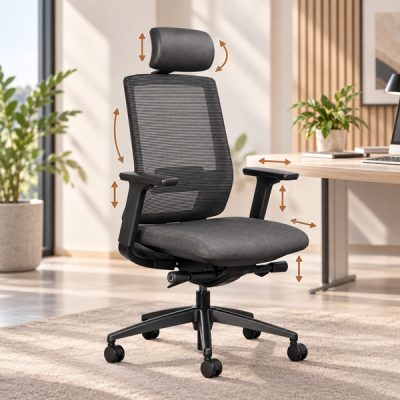
“Create Healthy Workspaces”
How many adjustments does an ergonomic office chair really need? And how can you compare the adjustability of different chairs?
Buying an ergonomic office chair can be confusing. One chair has adjustable lumbar support. Another has 3D armrests. Another has a seat slider, adjustable backrest and tilt tension. You can end up comparing a long list of technical features without knowing which chair gives you the most control over your seating position. That is why Karo developed the Karo Adjustability Rating.
It gives you a simple, transparent way to understand how much you can customise an ergonomic office chair to suit your body and the way you work.
What is the Karo Adjustability Rating?
The Karo Adjustability Rating measures the number of independent adjustments available on an office chair.
For example, a chair with an 8-Point Adjustability rating gives you eight independent ways to fine-tune the chair.
The exact adjustments vary from chair to chair. The rating is designed to make an otherwise complicated specification easier to understand.
Instead of simply seeing a list of features, you can quickly see how much control you have over the way your chair fits you.
These adjustments might include:
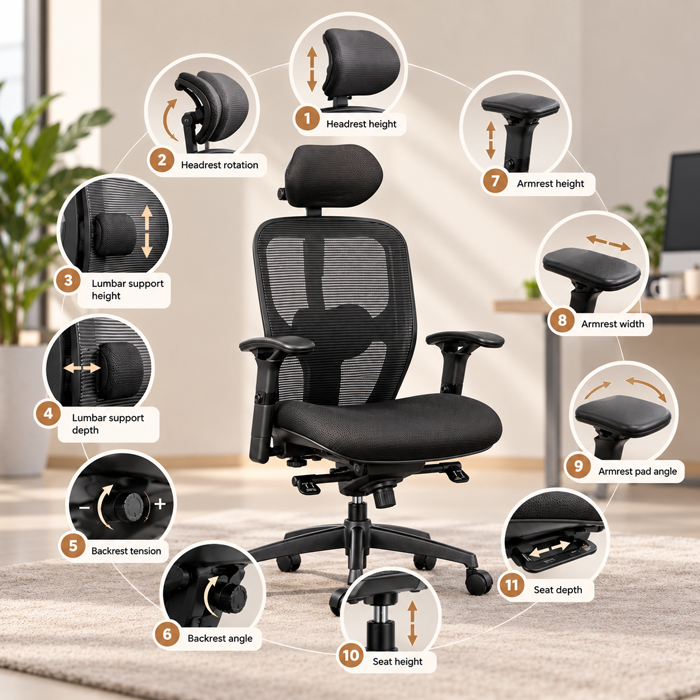
- Seat height
- Seat depth
- Backrest height
- Backrest angle
- Lumbar support height
- Lumbar support depth
- Armrest height
- Armrest width
- Armrest depth
- Armrest angle
- Headrest height
- Headrest angle
- Headrest rotation
- Seat tilt
- Tilt tension
The greater the points of adjustment, the easier it is to fine-tune the chair to suit your body and how you like to sit.
Why does adjustability matter?
There is no single sitting position that suits everyone. People differ in height, leg length, body shape, proportions, working habits and the amount of time they spend sitting. A chair that feels comfortable for one person may not provide the same fit for another.
Adjustability gives you greater control.
You can raise or lower the seat to suit your height. You can adjust the seat depth to support your legs correctly. You can position the lumbar support where you need it and set the armrests to support your arms without raising your shoulders. The more independent adjustments a chair provides, the more opportunities you have to fine-tune the chair to your body and your working position.
That is the fundamental idea behind the Karo Adjustability Rating.
Is a chair with more adjustments always better?
No. This is one of the most important things to understand about the Karo Adjustability Rating.
A chair with 12 adjustment points is not automatically a better ergonomic chair than one with 8. The rating measures quantity of adjustment, not overall chair quality. The right adjustments, correctly designed and positioned, are more important than simply having the greatest number. For example, seat height and seat depth can be highly important for achieving the right fit. Other adjustments may provide more precise fine-tuning. How an adjustable office chair can reduce back pain.
The Karo Adjustability Rating should be used as a comparison tool, not a score for the overall quality of a chair. The goal is not to find the chair with the highest number, rather the goal is to find the chair with the adjustments that are right for you.
How does Karo calculate the Adjustability Rating?
Karo uses a simple principle:
One adjustment point = one independent user-controlled adjustment.
If you can independently adjust the seat height, that is one adjustment point. If you can independently adjust the seat depth, that is another. If an armrest can move independently in three different directions, those independent movements can each count as an adjustment point. The important word is independent.
Note: The rating does not count every feature on a chair.
What does not count as an adjustment?
Features such as these do not earn adjustment points simply because they are present:
- Mesh upholstery
- Moulded foam cushioning
- Five-star bases and castors
- Weight capacity
- A mechanism or any other part of a chair that may or may not provide movement but doesn't allow independent user adjustment.
This keeps the Karo Adjustability Rating consistent and transparent across the range.
Why not just list the features?
Because a list of features does not always make it easy to compare chairs. Consider these two descriptions:
Chair A
- Adjustable armrests
- Adjustable lumbar support
- Seat slider
- Backrest tilt mechanism
- Adjustable backrest
- Lumbar support
Chair B
- 4D armrests
- Adjustable lumbar support
- Seat depth adjustment
- Synchronous mechanism
- Adjustable backrest
- Adjustable headrest
Which chair is more adjustable? It is not immediately obvious.
The Karo Adjustability Rating gives you a simple starting point.
You can see the number of independent adjustments and then look at exactly what those adjustments are. This makes it easier to compare chairs without needing to understand every piece of ergonomic terminology.
What does an 8-Point Adjustability rating mean?
An 8-Point Adjustability rating means the chair provides eight independent user-controlled adjustments according to the Karo Adjustability Rating methodology.
It does not mean that the chair is twice as good as a 4-point chair. It simply tells you that you have 8 different ways to customise the chair. The rating communicates how much you can adjust, not how good the chair is. It helps you move from “Which chair has the most features?” to “Which chair has the adjustments I actually need?”
Does more adjustability mean a higher-priced chair?
Adjustability is one factor that can contribute to the difference between office chairs. A chair with more independent adjustments gives you more ways to fine-tune your seating position. However, price can also reflect other factors, including materials, mechanisms, weight capacity, durability, warranty and ergonomic design. The Karo Adjustability Rating should be considered alongside the other specifications that matter to you. When comparing chairs, look at:
- Adjustability – How much can you customise the chair?
- Ergonomic support – Does it provide the support you need?
- Weight capacity – Is it suitable for your body weight?
- Recommended usage – Is it designed for the number of hours you sit?
- Warranty – What level of long-term protection is provided?
- Price – Does the overall specification suit your budget?
This gives you a much clearer picture of what you are actually buying.
Why did Karo develop its own Adjustability Rating?
Karo has been designing and supplying ergonomic office chairs since 1986. One of the biggest challenges when choosing an ergonomic chair is understanding the difference between products.
Manufacturers use different terminology to describe similar features. Some adjustments are obvious, while others are hidden inside mechanisms or technical specifications. Karo wanted to make this easier.
The Karo Adjustability Rating turns a complicated ergonomic specification into one simple number, while still showing you exactly what sits behind that number.
It gives you a consistent way to compare adjustability across the Karo range. More importantly, it gives you information you can use to make a more informed decision.
A more transparent way to compare ergonomic chairs
The Karo Adjustability Rating is not intended to tell you which chair to buy. It is designed to give you better information.
You can see how adjustable a chair is, understand what each adjustment does and decide which adjustments are important for your body, your work and your comfort.
That makes comparing chairs easier. Because Karo applies the same methodology across its range, you can compare one Karo chair with another using the same framework.
That is the purpose of the Karo Adjustability Rating: to make chair adjustability easier to understand.
Find the right level of adjustability for you
The right ergonomic chair is not necessarily the chair with the most adjustments. It is the chair that gives you the right combination of support, adjustability and fit for the way you work.
If you are still unsure, use the Karo Chair Selector to narrow down your options based on your individual requirements.
Your chair should fit you — not the other way around.
By the same author:
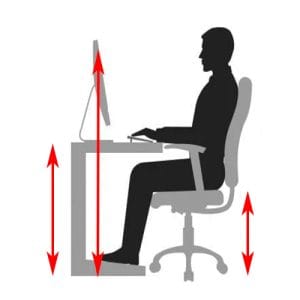

What is the Correct Ergonomic Height for my Office Chair, Desk and Computer Monitor?
Correct height settings for sitting and standing at work

What Is a Swivel Chair? Benefits, Types and How to Choose the Right One
A stylish and ergonomic swivel chair is a great choice for anyone looking to increase their productivity and comfort while working at home or in the office.

What Is A Heavy Duty Orthopedic Chair?
If you are Big & Tall or work in a 24/7 environment and you have a back problem, you need a special solution.