

The Health Risks of Sitting Too Long – and 5 Practical Ways to Reduce Them
- Updated:
About the author:

Ronel Hendry

“Create Healthy Workspaces”
If you spend six or more hours each day sitting at a desk, you're not alone. Modern office work often involves prolonged periods of sitting, and research has linked this sedentary behaviour to an increased risk of back pain, neck pain, cardiovascular disease and type 2 diabetes. The good news is that simple changes to the way you work can dramatically reduce the health risks of sitting too much. How Ergonomic Chairs Transformed My Work Life – My Journey with Nerve Pain in My Lower Back
Key Takeaways
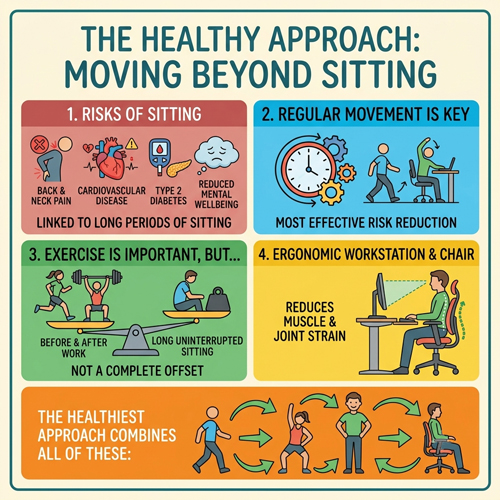
- Sitting for long periods has been linked to back pain, neck pain, cardiovascular disease, type 2 diabetes and reduced mental wellbeing - Mayo Clinic.
- Regular movement throughout the day is one of the most effective ways to reduce these risks.
- Exercise before, during or after work is important, but it does not completely offset long periods of uninterrupted sitting.
- A correctly adjusted workstation and ergonomic office chair help reduce strain on your muscles and joints.
- The healthiest approach combines movement, exercise, good posture and ergonomic equipment.
Is Sitting All Day Bad for You?
If you spend most of your working day behind a desk, you've probably asked yourself whether sitting for hours is harming your health. The short answer is yes, but the real issue isn't sitting itself. It's remaining in the same position for too long without moving.
Modern office work often involves sitting for six to ten hours each day. Over time, this lack of movement places stress on your muscles, joints and spine while also affecting your circulation and metabolism. Fortunately, you don't need to abandon your desk job to stay healthy. Small changes to the way you work can significantly reduce the physical strain of prolonged sitting.
What We've Learned from 40 Years of Ergonomic Assessments
Over the past 40 years, we've helped thousands of South Africans choose ergonomic seating for offices, call centres and control rooms. One of the biggest misconceptions we encounter is that buying a better chair alone will eliminate back pain.
In reality, the greatest improvements come from combining the right chair with a correct workstation setup and regular movement throughout the day.
What Happens to Your Body When You Sit for Too Long?
Your body was designed to move - see What actually happens when you sit? According to Mayo Clinic, when you remain seated for extended periods:
- Your hip flexors shorten and tighten.
- Your lower back experiences continuous pressure.
- Your neck and shoulders often lean forwards towards the screen.
- Blood circulation slows.
- Your muscles become less active, reducing calorie expenditure.
- Your joints become stiff.
These effects don't happen overnight, but repeated day after day they can contribute to discomfort, fatigue and chronic musculoskeletal problems.
Short-Term Effects of Sitting Too Much
Many office workers experience symptoms long before serious health problems develop. Common short-term effects include:
- Lower back pain
- Neck pain
- Shoulder tension
- Tight hips
- Headaches
- Stiff joints
- Poor circulation
- Fatigue
- Reduced focus or concentration.
If you regularly feel sore or tired by the end of your working day, prolonged sitting for long periods may be a contributing factor.
Long-Term Health Risks of Sitting Too Much
If you sit for most of your working day without moving, your circulation slows, your muscles stiffen and your body gradually becomes less efficient at regulating blood sugar. Over time, these changes can increase your risk of developing chronic health problems. Research has linked prolonged sedentary behaviour with an increased risk of several chronic health conditions. These include:
a. Musculoskeletal Disorders
Remaining in poor postures for long periods places additional stress on the spine, muscles and joints, increasing the likelihood of persistent back, neck and shoulder pain.
b. Cardiovascular Disease
Long periods of inactivity reduce circulation and are associated with an increased risk of heart disease, particularly when combined with other lifestyle risk factors.
c. Type 2 Diabetes
Reduced muscle activity affects how efficiently your body regulates blood sugar, increasing the risk of insulin resistance.
d. Weight Gain
Sitting burns fewer calories than standing or walking, making weight management more difficult when physical activity is limited.
e. Mental Wellbeing
Research suggests that prolonged sitting may also contribute to increased stress, anxiety and lower overall wellbeing. Less sitting is widely recommended as part of a healthy lifestyle.
Can Exercise Cancel Out the Health Risks of Sitting too Much?
Many people assume that going to the gym after work completely offsets eight hours of sitting. Unfortunately, it's not quite that simple. Regular exercise is one of the best things you can do for your health, but studies suggest that long periods of uninterrupted sitting still have negative effects. According to research by Lancet, "people who sat for 8 hours a day but were physically active for at least an hour per day had a much lower risk of death."
The goal is to combine regular exercise with frequent movement throughout the working day. Movement throughout the day protects your body from becoming sedentary.
How Often Should You Move at Work?
At work, the goal should be to get up from your desk every 45-60 minutes and move.
Go for a short walk, stretch your hips and shoulders, fetch a cup of coffee, or use a standing desk. Even a few minutes of movement can help to:
- improve circulation
- reduce muscle stiffness
- change spinal loading
- improve concentration
- reduce fatigue.
5 Ways to Reduce the Health Risks of Sitting too Much at Work
1. Move and Stretch Regularly
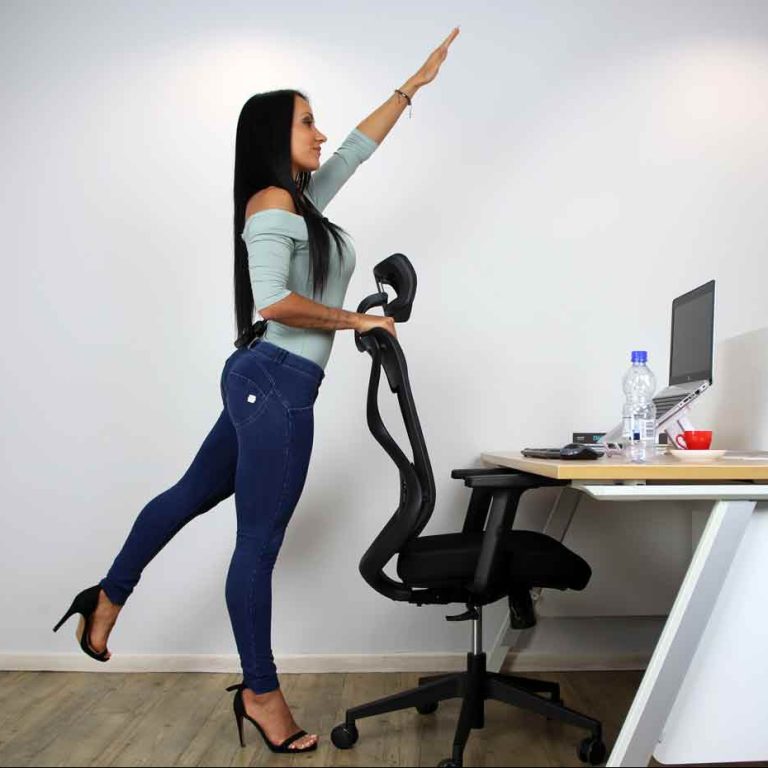
Frequent movement is one of the simplest and most effective ways to reduce the effects of prolonged sitting. Do some simple stretches for your neck, shoulders, hips and back to reduce stiffness and improve mobility.
2. Exercise Most Days
Aim for regular aerobic exercise combined with strength training to support your muscles, joints and cardiovascular health. WHO guidelines recommend that adults should do at least 150 mins of physical activity per week.
3. Adjust Your Chair Correctly and Maintain a Good Sitting Posture
An ergonomic chair only works properly when adjusted to fit your body. Seat height, lumbar support, armrests and backrest angle should all support a neutral sitting posture. Ergonomic Chair Setup Guide: 8 Mistakes To Avoid
4. Set Up Your Workstation Correctly
Your monitor should be approximately at eye level, while your keyboard and mouse should allow your shoulders to remain relaxed.
Poor workstation setup often causes more discomfort than the chair itself.
5. Stay Hydrated
Drinking enough water supports your overall health and naturally encourages you to stand up more often.
"A good workstation setup requires an Ergonomic Chair and adjustable Standing Desk."
Ergonomic benefits of a standing desk
Healthy Sitting Posture - Checklist
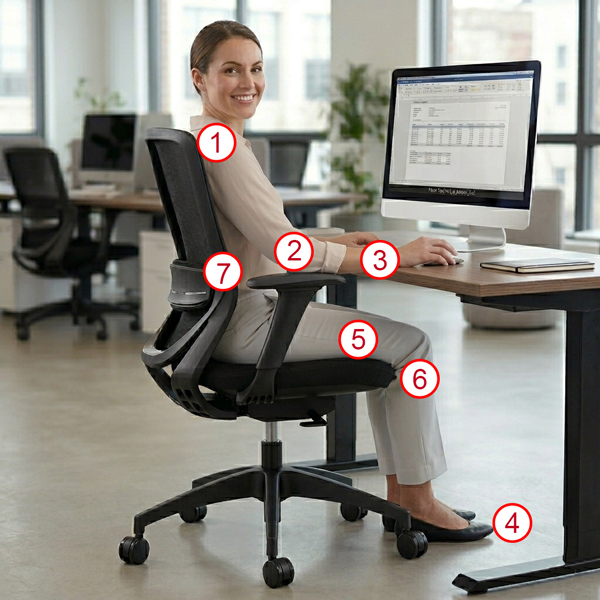
Use this quick checklist to improve your posture while sitting at your workstation:
- Shoulders relaxed, not elevated
- Elbows bent at roughly 90 degrees
- Forearms parallel to the floor and supported by the armrests or desk surface
- Feet flat on the floor or on a footrest
- Knees slightly lower than hips
- A 2-3 finger gap between front edge of the seat and the back of your knees
- Back fully supported by the backrest with the lumbar support fitted into the curve of your lower back.
Can an Ergonomic Office Chair Prevent Back Pain?
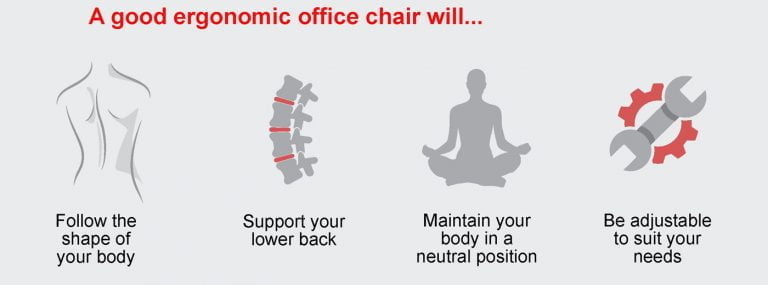
An ergonomic chair is not a cure for back pain. However, it can reduce many of the physical stresses that contribute to discomfort.
A quality ergonomic chair should enable Dynamic Sitting by allowing your body to make small, natural movements throughout the day instead of holding a single rigid posture.
Combined with correct workstation setup and regular exercise, an ergonomic chair helps create a healthier working environment.
Frequently Asked Questions (FAQ's)
a. Is sitting all day really bad for you?
Yes. Research has found that prolonged sitting is associated with an increased risk of musculoskeletal pain, cardiovascular disease, type 2 diabetes and poorer mental wellbeing. The risk is highest when sitting is uninterrupted for long periods. Regular movement, exercise, a correctly adjusted workstation and an ergonomic chair can all help reduce these risks.
b. How many hours of sitting is too much?
There is no single cut-off, but many adults spend more than eight hours sitting each day. Breaking up long periods of sitting is recommended regardless of your total sitting time.
c. Does standing all day solve the problem?
No. Standing continuously can also place strain on your body. Alternating between sitting, standing and moving is generally considered the healthiest approach.
d. How often should I stand up and move at work?
Aim to move every 45 to 60 minutes, even if it's only for a minute or two.
e. Can an ergonomic chair fix poor posture?
An ergonomic chair supports better posture, but it cannot correct poor habits on its own. Correct workstation setup and regular movement remain essential.
Conclusion
Sitting is an unavoidable part of many jobs, but its effects don't have to be. By moving regularly, exercising consistently, setting up your workstation correctly and choosing an ergonomic chair that supports healthy posture, you can greatly reduce discomfort and improve your long-term wellbeing. If you're replacing your office chair, choose one that encourages dynamic sitting, provides proper lumbar support and can be adjusted to fit your body. Even the best chair won't replace regular movement, but it can make every hour you spend sitting healthier and more comfortable.
By the same author:


How the Right Office Chair Can Help Your Back Pain
80% of office workers report having back pain at some point in their careers. Causes of upper and lower back pain are often attributed to poor workplace ergonomics.

How Ergonomic Chairs Transformed My Work Life – My Journey with Nerve Pain in My Lower Back
A case study of how I conquered debilitating back pain at work.

Home Office Setup: How To Create Your Perfect Workspace
Whether you work from home part-time or full-time, a good setup is essential!